• Skip to primary navigation
  • Skip to main content
  • Skip to primary sidebar
  • Skip to footer

Sino Machinery Industries

  • Home
  • About Us
  • Industries We Serve
    • SMI Products Overview
      • SMI Special Steel Products 01
      • SMI Special Steel Products 02
      • SMI Metal Recycling
      • NDT (Non Destructive Testing) service
  • Capabilities
    • Truck & Trailer Parts
      • R-Series weight distribution hitch with sway control system
      • G-Series weight distribution hitch
    • Cement Machinery Wear Parts
      • Casting Balls & Grinding Balls
    • Mining Machinery Wear Parts
      • Cone Crusher Parts
      • Jaw Crusher Parts
      • Screener Wear Parts
      • Impact Crusher Parts
    • Aluminum Industry
      • Aluminum Dross Press
      • Aluminum Dross Cooling Pan
      • Alloy Steel Sow Mold
      • Aluminum Dross Skim Blades and Skim Tools
      • Aluminum Furnace Skimming Tool or Skim blades used for Stirring and Mixing
      • Dross Press & Dross Processing
      • Application of Intelligent Ladle Slag Scraper (Skimming Tools) in steel mills and aluminum mills
      • Transmission Parts
      • The correct combination of the press head and the dross pan
      • 7-9kgs Small Standard Ingot Molds | Moldes de lingotes estándar pequeños de 7-9kgs
      • Comparison between Sow Molds and Ingot Molds
      • Aluminum Dross Transport Equipment
      • Aluminum Dross Recycling Systems
      • Aluminum, Magnesium, Brass, Bronze, Lead, Zinc Ingot Molds
      • Anode steel claw (Electrolytic claw) | Garra de acero del ánodo (garra electrolítica)
      • Anode Steel Yoke
  • eNews
  • Ethics & NDA
  • CSR
  • Contact Us
You are here: Home / Archives for secondary smelter

secondary smelter

February 10, 2025 By Sen Liang Leave a Comment

Dross Press vs Manual Dross Processing: ROI Analysis

Is a Hydraulic Dross Press Worth the Investment? A Financial and Technical Analysis

Aluminium dross is an unavoidable by-product of every melting and casting operation. How your facility manages that dross determines whether it represents a recoverable asset or a disposal cost — and the difference between the two can be substantial.

This article provides a technical and financial comparison between hydraulic dross pressing and conventional manual dross processing, to help plant managers and operations teams make a well-informed capital investment decision.


What Is Aluminium Dross?

When aluminium is melted, a layer of oxide-rich material forms at the surface of the melt. This material — dross — consists of a mixture of aluminium oxide (Al₂O₃), aluminium nitride, other metallic oxides, and critically, entrapped liquid aluminium metal.

The metallic aluminium content of hot dross varies significantly depending on:

  • Furnace type and operating practice
  • Alloy composition
  • Skimming technique and timing
  • Ambient temperature and humidity

In typical secondary smelting operations, hot dross contains 40–80% metallic aluminium by weight. This is the recoverable fraction — and it represents significant economic value that manual processing routinely fails to capture fully.


Manual Dross Processing: How It Works and Where It Falls Short

In manual processing, hot dross is skimmed from the furnace and either spread on the floor and raked while hot to release entrapped metal, or placed in a dross pan and allowed to cool before being broken up and screened.

The core problem with manual processing is timing. Once dross is removed from the furnace, oxidation continues rapidly. Every minute that passes before the metallic aluminium is separated from the oxide fraction means more metal lost to further oxidation.

Studies across multiple secondary smelter operations consistently show that manual processing recovers only 60–75% of the available metallic aluminium in hot dross. The remainder oxidises or remains entrapped in the oxide cake, ultimately sent for salt furnace processing or landfill — at additional cost.

Additional limitations of manual processing include:

  • Safety risks from handling hot dross in open environments
  • Inconsistent recovery rates depending on operator skill and attention
  • Dross fume emissions from prolonged hot dross exposure
  • No data capture — manual processes generate no records of dross volume, metal recovery rate, or oxide quality

How a Hydraulic Dross Press Works

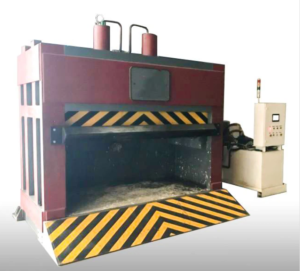
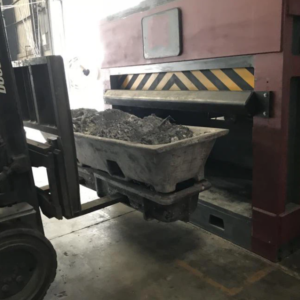
A hydraulic dross press applies controlled mechanical pressure to hot dross immediately after skimming — typically within 2–4 minutes of removal from the furnace. The pressing action forces liquid aluminium out of the oxide matrix and into a collection pan, where it solidifies into a recoverable metal button or sow.

The key operating principle is speed and pressure. By pressing the dross while it is still above the aluminium liquidus temperature (660°C), the metallic fraction flows freely under pressure. A well-operated dross press typically recovers 85–95% of the available metallic aluminium — a 15–30 percentage point improvement over manual methods.

Modern hydraulic dross presses also offer:

  • Enclosed pressing chamber — significantly reduces fume emissions and improves workplace safety
  • Consistent, repeatable process independent of operator skill
  • Digital monitoring of press cycles, dross weight, and metal yield
  • Reduced oxide cake volume, improving downstream handling and disposal economics

Financial Analysis: When Does a Dross Press Pay Back?

The return on investment for a dross press depends on three variables: dross volume, aluminium price, and current manual recovery rate.

Example calculation — medium-scale secondary smelter:

Parameter Value
Annual dross generated 1,200 tonnes
Average metallic Al content 55%
Available metallic Al 660 tonnes/year
Current manual recovery rate 68%
Metal recovered manually 449 tonnes/year
Dross press recovery rate 90%
Metal recovered with press 594 tonnes/year
Additional metal recovered 145 tonnes/year
Aluminium price (LME + premium) USD 2,400/tonne
Additional annual revenue USD 348,000/year

Against a capital investment of USD 180,000–320,000 for a mid-range hydraulic dross press (depending on capacity and specification), the simple payback period in this example is 7–11 months.

Even in operations with lower dross volumes or lower aluminium prices, payback periods under 24 months are common — making dross press investment one of the highest-return capital projects available to aluminium recyclers.


Four Factors That Affect Dross Press ROI

Dross Temperature at Pressing Time

The closer to furnace temperature, the higher the metal yield. Facilities that can position the dross press within 10–15 metres of the furnace tap consistently achieve better recovery than those with longer transport distances.

Dross Composition

High-oxide drosses (from reactive alloys or poor furnace practice) yield less metal regardless of pressing method. Improving furnace practice — lid management, flux use, skimming frequency — increases the available metal fraction before the dross press even comes into play.

Press Capacity Matching

A press that is undersized for your dross generation rate creates a bottleneck — dross cools while waiting and recovery rates drop. Matching press cycle time to furnace skimming frequency is a critical specification decision.

Oxide Cake Offtake

The pressed oxide cake (typically 10–20% residual Al content) still has value as a secondary raw material for salt furnace operators or cement producers. Establishing a reliable offtake agreement for pressed oxide cake improves the overall economics further.


Conclusion

For any aluminium melting operation generating more than 400–500 tonnes of dross per year, the financial case for hydraulic dross pressing is compelling. The combination of higher metal recovery, improved workplace safety, reduced fume emissions, and consistent process data makes it a sound investment by both financial and operational measures.

Manual processing has its place in very small-scale operations — but as a long-term strategy for any facility serious about metal yield and operational efficiency, it is not a competitive option.

Contact our engineering team for a site-specific ROI calculation based on your actual dross volumes and alloy mix.
Share this:

  • Share on LinkedIn (Opens in new window) LinkedIn
  • Share on Pinterest (Opens in new window) Pinterest
  • Share on Facebook (Opens in new window) Facebook
  • Share on X (Opens in new window) X
  • Share on WhatsApp (Opens in new window) WhatsApp
  • Share on Reddit (Opens in new window) Reddit
  • Share on Tumblr (Opens in new window) Tumblr
  • Share on Telegram (Opens in new window) Telegram
  • Email a link to a friend (Opens in new window) Email

Filed Under: Aluminium Casting Tagged With: aluminium recycling, Dross Press, dross processing, ROI analysis, secondary smelter

February 1, 2024 By Sen Liang Leave a Comment

Aluminum Dross Press

Aluminum Dross Press — In-House Dross Recovery Systems for Aluminum Casthouses

An aluminum dross press is the most effective method for recovering free metal from hot aluminum dross at the point of generation — before oxidation converts recoverable aluminum into oxide waste. By combining hydraulic compaction with forced cooling in a single automated cycle, a correctly specified dross press system typically achieves 20–35% in-house metal recovery, depending on operational conditions at the casthouse.

SMI designs, manufactures and commissions aluminum dross press systems as a complete supply — from the press frame and hydraulic unit through to the dross press cooling head, dross pan set and control system. Developed with over 30 years of experience in the aluminum recycling industry, SMI delivers dross press systems as engineered solutions matched to each customer’s furnace type, dross generation rate and casthouse configuration.

Aluminum Dross Press of Aluminum Dross Recovery

Why In-House Dross Processing Matters

Hot aluminum dross leaving the furnace still contains significant free metal — the exact proportion depending on furnace type, alloy, operating practice and how quickly the dross is handled after skimming. Without on-site pressing, dross is typically cooled slowly in open pans, allowing continued oxidation and thermiting that converts recoverable aluminum into aluminum oxide. This represents a direct and measurable production loss on every cast.

Sending unpressed dross to an external recycler recovers some of that metal, but at a fraction of its in-house value and with significant commercial and logistical dependencies. In-house pressing recovers the metal immediately, at full in-house value, and gives the operation direct control over its dross processing output.

Actual recovery rates in practice depend on several operational factors: the free metal content of the dross at skimming, the time elapsed between skimming and pressing, the distance from furnace to press, insulation conditions during transfer, and the condition of the pan-and-head set. The global average in-house aluminum recovery from dross processing is approximately 33% — SMI systems are designed to optimise all controllable variables within this range.


SMI Dross Press — Three Model Sizes

SMI supplies three standard dross press models, sized to match different furnace capacities and dross generation rates. All three models share the same engineering platform — hydraulic system architecture, control system, cooling head technology and dross pan design — with press capacity scaled to the installation requirement.

Model Single-Cycle Dross Capacity Typical Application
SMI40 250–300 kg per pressing cycle Smaller melting and casting facilities, secondary smelters, foundries
SMI60 450–500 kg per pressing cycle Medium-capacity primary and secondary smelters, recycling plants
SMI80 600–700 kg per pressing cycle High-volume primary smelters, large secondary operations

Custom configurations outside these standard ranges are available on request. Press capacity selection, pan geometry and cooling head specification are confirmed by SMI application engineers based on a review of the customer’s furnace type, dross generation rate and casthouse layout.


How the SMI Dross Press System Works

The SMI dross press operates on a fully automated, programmable cycle integrated with the casthouse workflow:

  • Hot dross is skimmed from the furnace and transferred directly to the dross pan — minimising the time between skimming and pressing is critical to maximising recovery
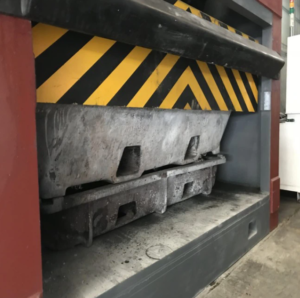
  • The loaded dross pan is positioned in the dross press box
  • The hydraulic cylinder drives the cooling head down into the dross box, compacting the dross under controlled pressure
  • The integrated cooling system activates simultaneously, extracting heat rapidly through the cooling head and arresting oxidation
  • The dross consolidates into a dense aluminum block with significantly reduced oxide content
  • The head retracts, the cycle completes, and the press is ready for the next pan

No manual intervention is required during the press cycle. Cycle parameters — pressure, hold time, cooling duration — are set to match the dross type and production rate of the specific installation. The automated operation reduces operator exposure to radiant heat and fume, and eliminates the skill variability associated with manual dross handling.


System Components and Specifications

Press Frame and Hydraulic System

The press frame is engineered for the compaction forces and thermal environment of continuous casthouse operation. The complete machine weight is approximately 15 tonnes. The hydraulic system is sized to the press capacity requirement and supplied as an integrated part of the press package.

SMI specifies hydraulic and electrical components from established global industrial suppliers as standard — pumps and valves from Rexroth, additional valves from SUN, filtration from HYDAC, and drive motors from Siemens. Alternative brands are available as specified by the customer. Component brand selection affects price, local serviceability, warranty terms and spare parts availability — SMI application engineers will advise on the most practical specification for each market and installation. In the event of on-site replacement, locally available motors and components of equivalent power and performance specification are fully compatible.

Dross Press Cooling Head

The dross press cooling head is the core performance component of the system. It delivers the compaction force and simultaneously extracts heat through an integrated forced-cooling circuit cast directly into the head body. SMI cooling heads are manufactured from the proprietary SMI ATM series anti-thermal-shock castable and are available in cooled and uncooled configurations across all geometries. The cooling head and dross pan are designed as a matched set to optimise seal geometry and heat transfer performance.

Dross Pan Set

The dross pan is the containment and transfer vessel for hot dross from furnace to press. SMI dross pans are cast from proprietary alloy steel formulations developed to resist the thermiting action and thermal shock of continuous hot dross service. Pan geometry is matched to the cooling head profile to ensure correct sealing under press pressure. Dross pan sets and press heads are manufactured and supplied to exact customer requirements for any dross press configuration.

Control and Automation System

The control system manages the full press cycle — hydraulic actuation, cooling circuit activation, pressure hold, cycle timing and head retraction — through a programmable controller. The system is designed for straightforward day-to-day operation and maintenance, with alarm and monitoring functions as standard. Remote monitoring capability is available as part of the control package.


System Design Considerations

SMI dross press system design takes into account the full operational context of each installation:

  • Furnace configuration — type, capacity and number of furnaces to be served
  • Material handling — forklift capacity, pan transfer method, casthouse layout and access
  • Dross characteristics — type, generation rate, free metal content and temperature at skimming
  • Utility supply — hydraulic, cooling water and electrical specifications
  • Recovery objectives — on-site recovery targets and downstream processing requirements

The goal of the design process is a system that maximises recovery both on-site and at any downstream secondary processor, within the operational and physical constraints of the specific casthouse.


Upgrade and Retrofit Supply

For operations with existing dross press installations, SMI provides upgrade and retrofit supply across the consumable and component range. If the press frame is serviceable but recovery performance has declined — due to worn cooling heads, degraded dross pans or control system limitations — SMI can supply replacement components without requiring full press replacement.

SMI cooling heads can be adapted to work with third-party press frames. Because hydraulic output, control parameters and commissioning requirements vary between press manufacturers, SMI conducts a technical review of the existing press specifications before confirming the adaptation scope. The full delivery scope — engineering review, component manufacture, on-site installation and commissioning — is available as a single-source engagement.


Delivery and Service

Parameter Details
Lead time Approximately 6~10 weeks from order confirmation
Shipping Ocean freight, 1 x 40HD container
Delivery terms DDP available; other Incoterms on request
On-site service Installation and commissioning support available
Spare parts Replacement cooling heads, dross pans and hydraulic components held in stock

Global Supply and Service

SMI has been supplying aluminum recycling systems and casthouse consumables since 1996, with over 30 years of manufacturing and export experience across legal entities in mainland China, Hong Kong, Southeast Asia, Europe and the United States. Annual mechanical product output exceeds 4,000 metric tons.

SMI dross press systems and casthouse consumables are in active service at primary aluminum smelters across the Middle East, Europe, India, North America and Asia-Pacific, including multiple operations within the world’s highest-output primary aluminum production groups. All supply relationships are subject to confidentiality agreements. Reference accounts are available to qualified buyers under appropriate confidentiality terms.


Application Sectors

  • Primary aluminum smelters
  • Secondary aluminum smelters and refineries
  • Aluminum rod, billet and bar plants
  • Metal recycling and non-ferrous scrap processing plants
  • Aluminum die casting and foundry operations
  • Magnesium and other non-ferrous metal recovery operations

Related Products — Complete Dross Management from SMI

  • Dross Press Cooling Head — cooled and uncooled variants, all geometries, matched to pan set
  • Dross Press Equipment Overview — system configurations, capacity planning and upgrade options
  • Dross Skim Pans and Sow Molds — pan-and-head matched sets, proprietary alloy steel
  • Aluminum Dross Cooling Pan — rapid salt cake cooling post-press
  • Dross Skim Blades and Casthouse Skimming Tools
  • Aluminum Dross Recycling Systems — full downstream processing: stirrer, cooler, crusher, screening and dust collection
  • Alloy Steel Sow Molds
  • Alloy Steel Ingot Molds, Sow Molds and Dross Pans for Aluminum Scrap Recycling

Request a System Quotation or Technical Consultation

To specify the correct dross press system for your operation, please provide the following at enquiry stage:

  • Furnace type and number of furnaces to be served
  • Estimated dross generation rate — tonnes per shift or pans per hour
  • Dross type: primary / secondary / rotary / other
  • Existing dross handling equipment — press frame, pan set, cooling system if applicable
  • Available utilities: hydraulic supply, cooling water, electrical specification
  • Casthouse layout drawing or dimensional constraints if available

SMI will respond with a written system recommendation and commercial proposal. Contact SMI — Aluminum Dross Press Enquiry →

Share this:

  • Share on LinkedIn (Opens in new window) LinkedIn
  • Share on Pinterest (Opens in new window) Pinterest
  • Share on Facebook (Opens in new window) Facebook
  • Share on X (Opens in new window) X
  • Share on WhatsApp (Opens in new window) WhatsApp
  • Share on Reddit (Opens in new window) Reddit
  • Share on Tumblr (Opens in new window) Tumblr
  • Share on Telegram (Opens in new window) Telegram
  • Email a link to a friend (Opens in new window) Email

Filed Under: Dross Management Tagged With: aluminium dross, Dross Press, dross processing equipment, metal recovery, secondary smelter

February 16, 2023 By Coffy Leave a Comment

Aluminum Dross Recycling Systems

Aluminum Dross Recycling Systems-1
Aluminum Dross Recycling Systems-2
Aluminum Dross Recycling Systems-3

With unique design, our aluminum dross recycling system manage the hot dross very effectively , the oxidation and metal loss will be terminated in a very short time, in-house metal recovery could be 70-80%, much higher than any other solutions.

The Aluminum Dross Recycling System covers the following equipment.

Dross stirrer
Dross cooler
Crusher and screening machine
Dust collector
Conveyor

Aluminum Dross Recycling Systems (partial photographs)

Share this:

  • Share on LinkedIn (Opens in new window) LinkedIn
  • Share on Pinterest (Opens in new window) Pinterest
  • Share on Facebook (Opens in new window) Facebook
  • Share on X (Opens in new window) X
  • Share on WhatsApp (Opens in new window) WhatsApp
  • Share on Reddit (Opens in new window) Reddit
  • Share on Tumblr (Opens in new window) Tumblr
  • Share on Telegram (Opens in new window) Telegram
  • Email a link to a friend (Opens in new window) Email

Filed Under: Dross Management Tagged With: aluminium recycling, Aluminum Dross Recycling Systems, Dross Press, metal recovery, secondary smelter

December 24, 2018 By Coffy Leave a Comment

SMI Dross Processing in Aluminum Recycling Operations

Dross Processing in Aluminium Recycling Operations — Pan Design, Press Configuration and Why Results Vary

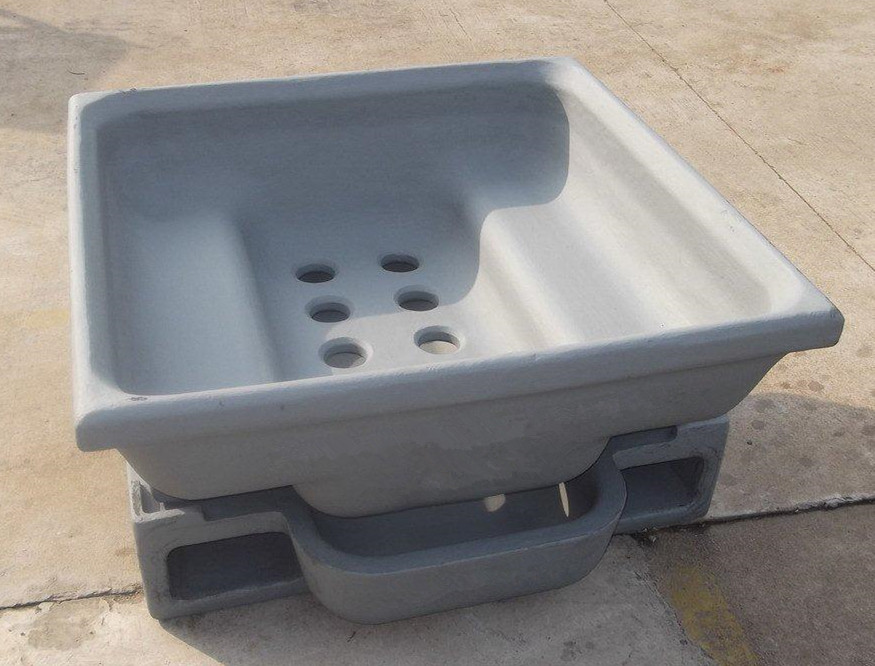
SMI alloy steel dross pan with multi-hole drain configuration and fork channels for aluminium casthouse dross processing
SMI alloy steel dross pan — multi-hole drain configuration with double counter-sink design, fork channels and large pan mass for maximum thermal cooling contact. Manufactured from proprietary alloy steel formulation for thermal shock resistance and long service life in continuous casthouse operation.

SMI has been supplying dross pans and dross press systems to the aluminium industry for over 30 years. Since 2009, Mr. David Roth has been our head consultant, bringing decades of experience in the global aluminium industry to SMI’s equipment design and customer application work.

All of the major players in aluminium melting and casting have purchased SMI quality castings. The observations in this article are drawn from that operational experience — from installations that worked well and from installations that did not, and from understanding precisely why the difference occurred.


The Dross Pan — Where Recovery Begins

The dross pan is not a passive container. Its design directly determines how much metal is recovered in the pressing cycle that follows. The unique characteristics of SMI’s dross pan design allow for a significant degree of cooling contact between the dross and the cast steel — a function of pan mass, geometry and surface area that cannot be replicated by a simple fabricated vessel.

The drain hole configuration is a specific engineering decision, not a standard feature. The number of holes and the double counter-sink design allows for the maximum drain possible without dross sticking in the holes — a failure mode that renders the drain function ineffective and forces operators to intervene manually. The distance between the skim position and the sow mould is also considered carefully in the pan design, to allow large drain volumes without the pans freezing together during the transfer process.

The cooling cycle for correctly specified dross pans is approximately two hours before the material can be rotated out. The large pan mass is critical to achieving this result — it is what drives the thermal extraction that makes the subsequent pressing cycle effective.

Some earlier pan designs in the industry relied on single-hole drain configurations. A single drain point is inherently prone to blockage given the viscosity and oxide content of hot dross — when it blocks, the entire drain function is lost. The single-chamber pan geometry also limits the cooling and plating action achievable during pressing. SMI’s multi-hole, double counter-sink design addresses both failure modes directly.

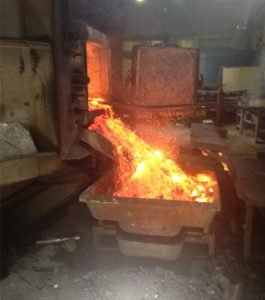
Hot aluminium dross being skimmed from furnace into SMI dross pan — casthouse operation
Hot aluminium dross being skimmed from the furnace into the dross pan — time from skimming to pressing is the critical variable in metal recovery
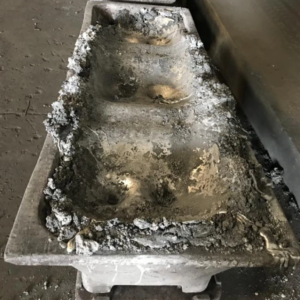
Liquid aluminium visible in freshly skimmed hot dross — immediate pressing required to prevent oxidation loss
Liquid aluminium visible in freshly skimmed hot dross — oxidation begins immediately after skimming
Forklift transfer of loaded SMI dross pan to aluminium dross press — fork channel design accommodates standard casthouse material handling
Forklift transfer of loaded dross pan to the dross press — pan design accommodates standard fork truck specifications for each installation

Press Capacity — The Operational Variable Most Often Underestimated

The most consistent cause of dross press underperformance in the field is not equipment quality — it is insufficient press capacity relative to the dross generation rate of the operation.

The mechanism is straightforward. Hot dross skimmed from the furnace begins oxidising immediately. The cooling and plating action that is the primary benefit of pressing — the conversion of liquid aluminium droplets into a recoverable solid block — requires the dross to reach the press while still at temperature. If a dross pan sits for more than 15 minutes before pressing, this process is already significantly compromised. The dross has cooled, the liquid aluminium has partially oxidised, and the pressing cycle produces a result that does not reflect the capability of the equipment.

When multiple pans queue in front of a single press, the pans at the back of the queue are already cold before they are processed. Operators observe poor results, conclude that pressing is ineffective, and gradually stop using the equipment — not because the press is at fault, but because the system was never configured with adequate capacity for the volume of dross being generated.

The practical implication for system specification is direct: the number of presses required for an operation is determined by the dross generation rate and the 15-minute processing window — not by capital budget alone. An undercapacity installation does not produce partial results; it produces results that appear to confirm that pressing does not work, which is a different and more damaging outcome.


The Pan and Press Head as a Matched System

The most important engineering decision in a dross press installation is the casting design of the pan and the press head as a matched pair. The press head must seat correctly against the pan walls to maintain an effective seal under hydraulic pressure — a poor geometric match allows dross to escape under compression and breaks the thermal contact that drives cooling performance.

SMI designs the pan and press head together, specifically for each customer’s furnace configuration, dross volumes and material handling capabilities — fork truck specifications, transfer distances and pan positioning. The combination of pan design and press head geometry determines the fastest possible cooling rate, the highest achievable drain volume and the most effective plating action for the specific dross type being processed.

The press itself — hydraulics, frame, automation — is in SMI’s view a delivery mechanism for the casting design. A high-quality press delivering poor results is almost always a pan-and-head geometry problem, not a press problem. SMI’s focus is on providing a high-quality, simple, low-maintenance press that fully utilises the recovery capability built into the casting design.


Operational Recommendations

Based on over 30 years of dross press installations across primary smelters, secondary smelters and recycling operations, SMI’s application engineering team consistently observes the following in operations that achieve the best results:

  • Minimise time from skimming to pressing — the 15-minute window is a real operational constraint, not a guideline. Workflow design should prioritise getting hot dross to the press as the first priority after skimming.
  • Size press capacity to dross generation rate — calculate the number of pans generated per shift and confirm that press capacity can process them all within the 15-minute window. If the numbers do not support a single press, two presses is the correct specification.
  • Specify pan and press head as a matched set — do not select the press and the pan independently. The geometric relationship between them is the primary determinant of recovery performance.
  • Maintain the pan-to-head seal — a worn or damaged mating face on either the pan or the head degrades recovery performance continuously. Replacement scheduling should be based on dimensional inspection, not visible failure.
  • Account for dross type — different furnace types and alloy practices produce dross with different characteristics. Pan and head geometry should be confirmed for the specific dross type being processed, not selected from a generic catalogue.

SMI Dross Pan Design — Key Features

Design Feature Function Failure Mode Addressed
Multi-hole drain configuration Maximum drain volume during pressing Single-hole blockage — loss of drain function
Double counter-sink hole design Prevents dross sticking in drain holes Hole blockage requiring manual intervention
Large pan mass Thermal mass drives cooling contact with dross Insufficient cooling — poor plating action
Pan-to-head matched geometry Effective seal under hydraulic pressure Dross escape and thermal seal failure under compression
Furnace-specific dimensioning Correct volume for furnace dross output Undersized or oversized pans relative to dross generation
Fork truck compatibility Safe transfer from furnace to press Handling delays that extend the pre-press window beyond 15 minutes

Related Products

  • Dross Skim Pans and Sow Moulds — matched pan-and-head sets, proprietary alloy steel
  • Dross Press Cooling Head — cooled and uncooled variants, all geometries
  • Aluminum Dross Press — SMI40, SMI60, SMI80 and custom configurations
  • Dross Press Equipment Overview — system configurations and upgrade options
  • Press Head and Dross Pan — matched configuration guide
  • Aluminum Dross Cooling Pan — post-press salt cake and dross cooling unit
  • Aluminum Dross Recycling Systems — complete downstream processing line

Contact SMI — Dross Processing Application Enquiry

To discuss dross pan and press head specification for your operation, or to review an existing installation that is not achieving expected recovery results, please contact SMI’s application engineering team. Please provide your furnace type, dross generation rate per shift, current pan and press configuration, and dross type.

SMI will respond with a written assessment and recommendation. Contact SMI →

Share this:

  • Share on LinkedIn (Opens in new window) LinkedIn
  • Share on Pinterest (Opens in new window) Pinterest
  • Share on Facebook (Opens in new window) Facebook
  • Share on X (Opens in new window) X
  • Share on WhatsApp (Opens in new window) WhatsApp
  • Share on Reddit (Opens in new window) Reddit
  • Share on Tumblr (Opens in new window) Tumblr
  • Share on Telegram (Opens in new window) Telegram
  • Email a link to a friend (Opens in new window) Email

Filed Under: Dross Management Tagged With: Aluminum Recycling, dross pan, Dross Press, dross processing, secondary smelter, SMI

Primary Sidebar

  • Home
  • About Us
  • Industries We Serve
    • SMI Products Overview
      • SMI Special Steel Products 01
      • SMI Special Steel Products 02
      • SMI Metal Recycling
      • NDT (Non Destructive Testing) service
  • Capabilities
    • Truck & Trailer Parts
      • R-Series weight distribution hitch with sway control system
      • G-Series weight distribution hitch
    • Cement Machinery Wear Parts
      • Casting Balls & Grinding Balls
    • Mining Machinery Wear Parts
      • Cone Crusher Parts
      • Jaw Crusher Parts
      • Screener Wear Parts
      • Impact Crusher Parts
    • Aluminum Industry
      • Aluminum Dross Press
      • Aluminum Dross Cooling Pan
      • Alloy Steel Sow Mold
      • Aluminum Dross Skim Blades and Skim Tools
      • Aluminum Furnace Skimming Tool or Skim blades used for Stirring and Mixing
      • Dross Press & Dross Processing
      • Application of Intelligent Ladle Slag Scraper (Skimming Tools) in steel mills and aluminum mills
      • Transmission Parts
      • The correct combination of the press head and the dross pan
      • 7-9kgs Small Standard Ingot Molds | Moldes de lingotes estándar pequeños de 7-9kgs
      • Comparison between Sow Molds and Ingot Molds
      • Aluminum Dross Transport Equipment
      • Aluminum Dross Recycling Systems
      • Aluminum, Magnesium, Brass, Bronze, Lead, Zinc Ingot Molds
      • Anode steel claw (Electrolytic claw) | Garra de acero del ánodo (garra electrolítica)
      • Anode Steel Yoke
  • eNews
  • Ethics & NDA
  • CSR
  • Contact Us

Footer

Customized Products & Services

Professional Aluminum & Magnesium plant equipment supplier from China.
Up to 4,000 metric tons of mechanical products annually.
More than 30 years’ manufacturing and export experience.
Serving Global Aluminum & Magnesium smelters and metal recycling industry since 1996.

Recent Products & Services

  • High-Performance Aluminum Ingot Molds: The Complete Selection Guide
  • Ingot Mold Failure Modes: Causes, Prevention & Lifespan Tips
  • Global OEM Supply Chain: Heavy-Duty Crusher Wear Parts Manufacturing
  • Low Temperature Threaded Check Valve VS Flanged Check Valve
  • Stainless Steel SS304 SS316 Investment Casting Wing Nut with Machining

Found favorite parts & services

Sino Machine Industries — Heavy Industry Supplier with 30 Years of Manufacturing Expertise in Aluminium, Crushing & Transmission Parts. Serving primary smelters, recycling plants and OEM clients across 30+ countries. Get a free quote: [[email protected]]
  • Home
  • Site Map
  • Privacy Policy
  • Terms of Use
  • Download Center
  • Ethics & NDA
  • CSR
  • Contact Us

Copyright © 2026 Sino Machine Industries (SMI) Serving Global Machinery Markets Since 1996

Loading Comments...

You must be logged in to post a comment.