A Complete Technical Comparison: Aluminium Plant vs Steel Plant Skimming Tools
1. Why Aluminium and Steel Plants Need Entirely Different Skimming Tools
The word “skimming” describes the same basic act in both industries — removing the oxide and impurity layer from the surface of molten metal. But beyond that surface similarity, the two applications differ on almost every dimension that matters for tool design.
- Melt surface temperature: 700–900°C
- Dross density: lower than the melt — floats freely
- Dross type: aluminium oxide (Al₂O₃), semi-solid to viscous
- Chemical aggressiveness: low — minimal attack on iron tools
- Tool priority: wide coverage, metal recovery through perforations, low iron contamination risk
- Skimming force required: moderate
- Melt surface temperature: 1,400–1,650°C
- Slag density: high — sits as a heavy viscous layer
- Slag type: silicates, oxides — aggressive, corrosive, sparking
- Chemical aggressiveness: very high — dissolves standard steels rapidly
- Tool priority: extreme heat resistance, high force, chemical durability
- Skimming force required: high to very high
The operating temperature in a steel plant (up to 1,650°C) is nearly twice the temperature in an aluminium smelter (700–900°C). This single fact drives every downstream difference in material grade, tool geometry, handle length, coating type, and automation level. No aluminium skimming tool — regardless of how it is coated — can survive in a steelmaking environment without a complete redesign.
2. Primary vs Secondary Aluminium Smelters: An Important Distinction
Before comparing aluminium versus steel, it is important to note that not all aluminium plants are the same. The skimming tool requirements differ significantly between primary aluminium smelters (which produce virgin aluminium via electrolysis) and secondary aluminium plants (which re-melt aluminium scrap).
| Factor | Primary Aluminium Smelter | Secondary (Recycled) Aluminium Plant |
|---|---|---|
| Raw material | Alumina (Al₂O₃) from bauxite, via Hall-Héroult electrolysis | Aluminium scrap: UBC, profiles, castings, mixed grades |
| Dross type | White dross — 50–80% metallic Al; recoverable; lower oxide content | Black dross — 10–30% metallic Al; coatings, oils, salts; harder to process |
| Furnace types | Reverberatory casting furnaces; large electrolytic cells (no skimming needed in cells) | Reverberatory furnace; Tilting Rotary Furnace (TRF) for contaminated scrap |
| Skimming tool design | Wide flat rake; long handle (2.5–3.5 m); mechanised skimming arms at large facilities | Heavier-duty tools; perforated designs for metal recovery; curved scrapers for TRF drum opening |
| Iron contamination risk | Low — brief contact; primary melt is pure | Higher — prolonged contact raises Fe contamination; coated or SiC tools preferred |
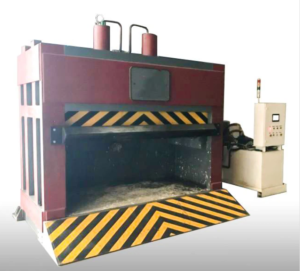
| Dross press relevance | High — white dross has high metallic Al recovery value | High — but requires more sophisticated processing for black dross |
Always establish whether the customer is a primary or secondary smelter before specifying tools. A secondary plant with a tilting rotary furnace (TRF) needs entirely different tool geometry — shorter handle, curved head profile matched to the drum opening — compared to a primary plant’s large reverberatory furnace requiring long-handle wide rakes. Sending the wrong tool is a common and costly procurement mistake.
3. Furnace Type and Door Geometry: How the Furnace Shapes the Tool
Skimming tool geometry is not a free design choice — it is directly constrained by the furnace opening through which the tool must operate. This is one of the most commonly overlooked factors in tool specification.
3.1 Aluminium Plant Furnace Types
Reverberatory Furnace
The reverberatory furnace is the dominant melting and casting furnace in both primary and secondary aluminium. It features a wide, flat bath with access through a front or side door (typically 0.8–1.5 m wide). This wide opening allows long-handle rakes and ladles to reach the full bath width. The flat bath geometry favours a shallow tool angle and wide head profile.
Tilting Rotary Furnace — TRF
The TRF is the dominant technology for processing contaminated and mixed scrap in secondary aluminium. The furnace is a rotating drum that tilts to discharge slag and metal. Access is exclusively through the drum end opening (typically Ø500–800 mm) — a restricted circular aperture that eliminates the use of wide, flat rakes entirely.
The TRF’s drum geometry, tilting angle mechanism, internal refractory lining, and flux injection system are typically proprietary to the furnace OEM. Key OEM suppliers include Hertwich Engineering (Austria), Gautschi Engineering (Switzerland), StrikoWestofen (Germany), JASPER GmbH (Germany), and Tenova (Italy). Tool suppliers must design skimming tools to fit OEM-specified drum inner diameters without replicating protected geometric designs.
3.2 Steel Plant Furnace Types
| Furnace Type | Opening / Access Point | Slag Volume | Skimming Tool Implication |
|---|---|---|---|
| BOF (Basic Oxygen Furnace / Converter) | Large top vessel mouth, Ø4–8 m; tap-hole in base/side | 100–130 kg/t steel | Crane-mounted large slag pusher, custom to vessel diameter; ZG40Cr25Ni20 steel |
| EAF (Electric Arc Furnace) | Water-cooled slag door in furnace shell (~300–500 mm slot); EBT bottom tap | 60–80 kg/t | Angled scraper matched to slag door slot width; high-alloy steel + ceramic coating |
| LF (Ladle Furnace) | Top electrode openings; side slag door (smaller) | 15–30 kg/t (secondary refining slag) | Compact ladle skimmer; 3–5 m handle; MgO-coated tip; hand or mechanised |
The EBT (Eccentric Bottom Tapping) system is patented in various configurations by Primetals Technologies and SMS Group. The tap-hole geometry and sand-filling system are proprietary. The Consteel® continuous scrap charging system is patented by Intersteel Technology Inc. Tool suppliers must not replicate these protected systems.
4. Skimming Blade Design: Aluminium vs Steel Plant
The skimming blade (also called the working head, skim paddle, or scraper head) is the tool element in direct contact with the melt surface. Its profile, material, and geometry are entirely application-specific.
4.1 Aluminium Plant Skimming Blade Profiles
Because aluminium dross floats on the melt surface and is relatively low-density, the primary design goal is maximum surface coverage at minimum contact depth — keeping the blade skimming the dross layer without disturbing the molten aluminium below.
- Wide flat rake: 400–600 mm wide; shallow angle entry; removes dross from large bath areas in a single pass. Standard tool for reverberatory furnaces.
- Perforated skimmer ladle: Allows molten aluminium to drain back through perforations (typically Ø15–25 mm) while retaining the dross. Critical for maximising metal recovery from white dross before it reaches the dross pan.
- Push plate: A flat paddle used for the final bath cleaning pass before tapping, pushing residual dross to one side.
- Curved end scraper (TRF-specific): Profile matched to the drum inner diameter (Ø500–800 mm); shorter and heavier-duty; designed to operate through the restricted drum end opening.
4.2 Steel Plant Deslagging Blade / Scraper Profiles
Steel plant slag is dense, viscous, and highly corrosive at extreme temperatures. The blade must apply significant force to push or scrape the slag layer while surviving the chemical and thermal environment without rapid failure.
- BOF slag pusher: Large flat or angled blade, custom to converter vessel diameter; typically crane-mounted; designed for single-pass slag displacement before and after tapping.
- EAF slag door scraper: Angled blade profiled to fit through the water-cooled slag door slot (300–500 mm); must clear the door aperture at working angle.
- LF ladle skimmer: Compact head; MgO-coated working surface; designed for thin synthetic slag layer removal without disturbing the refined steel below.
Aluminium skimming blades are designed for coverage and drainage — moving large surface areas of low-density dross while allowing liquid metal to return to the melt. Steel plant deslagging blades are designed for force and durability — pushing dense, sticky, high-temperature slag with sufficient mechanical force to clear the furnace or ladle surface.
5. Skimming Arms and Mechanised Deslagging Systems
A skimming arm is the structural assembly that holds, positions, and drives the skimming blade. The degree of automation — from manual poles to fully robotic systems — varies significantly between aluminium and steel applications.
5.1 Aluminium Plant Skimming Arms
In aluminium casthouses, skimming arms range from simple hand-operated poles to fully mechanised multi-axis arms mounted on the furnace platform.
| Arm Type | Application | Handle Length | Key Features |
|---|---|---|---|
| Manual pole (carbon steel) | Small reverberatory or induction furnace | 1.5–3.5 m | Simple, low cost; operator controls angle and pressure manually |
| Semi-mechanised push/pull arm | Medium reverberatory furnace | 2.5–4.0 m | Mechanical assist for extension/retraction; reduces operator fatigue |
| Mechanised skimming arm | Large primary smelter casting furnaces | N/A — machine-mounted | Hydraulic or electric drive; 2–4 axes of motion; operator-controlled from console |
| TRF end-door scraper set | Secondary Al tilting rotary furnace | ≤1.5 m (restricted by drum opening) | Curved profile; heavy-duty; matched to drum inner Ø; shorter stroke |
5.2 Steel Plant Deslagging Arms and Machines
Steel plant deslagging systems are significantly more mechanised, driven by the much higher temperatures and forces involved. Manual operations are the exception rather than the rule at large facilities.
| System Type | Application | Key Specifications |
|---|---|---|
| Overhead crane-mounted slag pusher | BOF / Converter tapping area | Custom to vessel diameter (4–8 m); ZG40Cr25Ni20; consider water-cooled variants |
| EAF slag door scraper | EAF slag door opening | Must fit through 300–500 mm slag door slot; high-alloy steel + ceramic coating; water-cooled handle option |
| Ladle deslagging machine | LF ladle furnace, torpedo car | 4-axis full hydraulic drive (lift, tilt, swing, extension); 2,000 mm stroke; 15 kN force; handles ≤50T ladles; on-site console or optional remote operation |
| Automated robotic slag raker | Large EAF / high-automation BOF facilities | Fully automated with machine vision; reduces operator exposure; large capital investment |
The hydraulic ladle deslagging machine used in steelmaking represents a significant step up in engineering complexity from aluminium skimming arms. A full hydraulic system with 4 independent motion axes (vertical lift 300 mm, extension 2,000 mm, tilt ±15°, swing ±20°) delivers a deslagging force of 15 kN at up to 16 MPa system pressure — capabilities that would be entirely over-specified and unnecessary in an aluminium casthouse, where dross is far lighter and furnace temperatures are hundreds of degrees lower.
6. Dross Pans and Slag Pans: Collection Vessel Differences
The dross pan (or slag pan) is the receiving vessel into which skimmed dross or slag is deposited after removal from the furnace. Like the skimming tools themselves, the requirements diverge significantly between aluminium and steel applications.
6.1 Aluminium Dross Pan
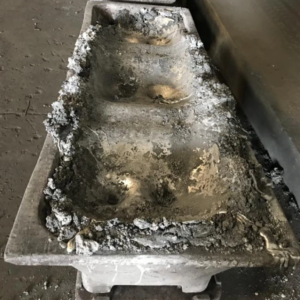
In an aluminium casthouse, dross pans are typically cast iron vessels sized to fit beneath the furnace door opening. Their primary functions are:
- Receive hot dross directly from the skimming blade during the skimming operation
- Retain the heat of the dross (critical — see dross press efficiency note below)
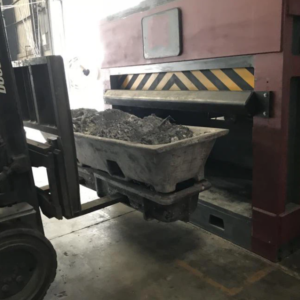
- Transport the dross to the dross press within the shortest possible time
- Allow initial drainage of any free liquid aluminium back through perforations (on perforated pan designs)
Key specifications for aluminium dross pans:
- Material: Cast iron (HT200–HT300) or ductile iron (QT450); heat-resistant alloy steel for high-throughput operations
- Coating: Refractory wash or boron nitride (BN) release coating to prevent aluminium adhesion and extend service life
- Typical service life: 6–18 months (primary smelter conditions)
- Design consideration: Thermiting dross (dross that re-ignites due to exothermic reaction) can warp and bow standard pans — proprietary alloy formulations significantly extend service life under thermiting conditions
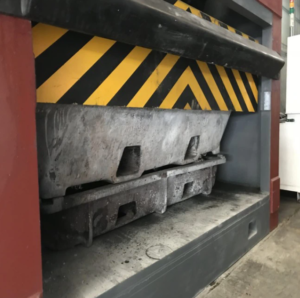
The time between skimming the dross into the pan and feeding it into the dross press is the single most important variable in aluminium recovery from dross. White dross at over 600°C contains liquid aluminium that separates easily under press pressure. Below 400°C, the aluminium has solidified and recovery drops sharply. Every 10 minutes of cooling represents approximately 30–50°C of temperature loss and a measurable reduction in recovery. See our dross press guide for full recovery rate analysis.
6.2 Steel Plant Slag Pan
Steel plant slag pans handle far larger volumes of far more aggressive material. Key differences from aluminium dross pans:
- Size: Much larger (tonnes per pour, not kilograms) — handled by overhead crane, not manually transported
- Material: High-alloy steel, sometimes water-cooled shells for high-throughput applications
- Temperature: Must handle initial contents at 1,400°C+
- Recovery: Steel slag is not typically pressed for metal recovery in the same way; the focus is disposal or slag valorisation (cement, road base)
- Service life: Shorter per cycle, but handled with crane systems that reduce physical wear compared to manual aluminium pans
7. Material Selection and Protective Coatings
| Component | Aluminium Plant | Steel Plant | Rationale for Difference |
|---|---|---|---|
| Working head / blade | Cast iron HT200–HT300 or Ductile iron QT450-10 |
ZG40Cr25Ni20 high-alloy heat-resistant steel or ceramic-coated steel |
Steel plant operating temperature would destroy cast iron within minutes; high-Cr alloys resist slag attack and thermal shock at 1,400–1,650°C |
| Handle / shank | Carbon steel tube or bar (S235/Q235) | Carbon steel with heat-resistant coating; water-cooling available for extreme applications | Radiant heat from steel furnaces requires active cooling for long handles; aluminium furnace handles can be standard steel |
| Protective coating | Refractory wash or Boron Nitride (BN) release agent |
Plasma-sprayed ZrO₂ or Al₂O₃ ceramic; some proprietary coatings | BN coating prevents aluminium adhesion and extends life 30–50%; steel plant coatings must survive far higher thermal and chemical load |
| Dross / slag pan | Cast iron HT200–HT300; some ceramic-lined variants | High-alloy steel; water-cooled shell variants for BOF | Temperature and slag aggressiveness drive material choice; aluminium dross pan requires good thermal retention, not just thermal resistance |
| LF / ladle deslagging tip | N/A | MgO-coated working tip preferred | MgO resists attack by basic (high-CaO) LF synthetic slag; no equivalent requirement in aluminium |
In aluminium casthouses, a boron nitride release coating on both skimming blades and dross pans is the most cost-effective life extension measure available. BN acts as a non-wetting barrier between the iron surface and molten aluminium, reducing metal adhesion and dross sticking. A well-applied BN coating can extend skimming tool life by 30–50% and significantly reduces the iron contamination risk in primary aluminium operations. Reapplication frequency depends on tool cycling rate and bath temperature.
8. Skimming Efficiency and Dross Recovery: What the Numbers Actually Mean
Efficiency metrics for skimming tools are often misunderstood — particularly in the context of aluminium dross recovery. The numbers cited in different sources appear inconsistent because they measure fundamentally different things.
8.1 Aluminium Dross Recovery: Three Different Metrics
There are three distinct ways to express recovery performance in aluminium dross management. Confusing them is the source of most disagreement about “recovery rates.”
| Metric | Formula | Typical Value | What It Measures |
|---|---|---|---|
| ① Dross Al content | Metallic Al in dross ÷ Total dross weight | White dross: 50–80% Black dross: 10–30% |
Input material quality — not a recovery rate |
| ② Press equipment efficiency | Al pressed out ÷ Al originally in the dross | 60–90% (ideal conditions) | How well the press extracts Al from what it receives |
| ③ System recovery rate | Total Al pressed out ÷ Total dross weight fed in | 15–60% (real plant conditions) | Net Al yield per kg of dross — the number that drives ROI |
The widely cited “70–90%” figure in industry literature refers to Metric ② under ideal conditions — fresh hot white dross processed immediately. The real-world figure of 15–35% (Metric ③) reflects mixed dross types, cooling losses, and operational variables. Both numbers are correct — they simply measure different things.
8.2 Numerical Example: How Dross Temperature and Type Drive the Result
Press equipment efficiency (Metric ②): 85%
Al pressed out: 700 × 85% = 595 kg
System recovery rate (Metric ③): 595 ÷ 1,000 = 59.5%
Press efficiency (cooling + mixed feed): ~72%
Al pressed out: 500 × 72% = 360 kg
System recovery rate (Metric ③): 360 ÷ 1,000 = 36%
Press efficiency (cold, high-impurity dross): ~65%
Al pressed out: 250 × 65% = 163 kg
System recovery rate (Metric ③): 163 ÷ 1,000 = 16.3%
Mixing white dross (50–80% Al) with black dross (10–30% Al) before pressing directly dilutes the feed and reduces Metric ③. The loss is not due to the press — it is a feedstock management failure. Segregate white dross and black dross from the moment of skimming, route them through separate processing paths, and press white dross as hot as possible.
8.3 Steel Plant Deslagging Efficiency
In steelmaking, the efficiency metric for deslagging is different in character. The goal is not metal recovery from slag (as in aluminium) but rather:
- Slag carry-over reduction: Minimising the amount of slag transferred into the ladle during tapping — directly affects steel cleanliness and downstream refining costs
- Clean tapping: EBT systems in EAF and slag detection systems in BOF are specifically engineered to minimise slag carry-over
- Deslagging completeness: In LF operations, removing the slag layer from the ladle surface before casting prevents inclusions in the final product
For steel plant ladle deslagging machines specifically, the key efficiency indicators are deslagging force (kN), stroke coverage, and the ability to operate continuously for ≥10 minutes without component deformation — not a metal recovery percentage.
9. Master Comparison Table: Aluminium vs Steel Skimming Tools
| Parameter | Aluminium Plant | Steel Plant |
|---|---|---|
| Operating temperature | 700–900°C (melt surface) | 1,400–1,650°C (melt surface) |
| Dross / slag characteristics | Low-density Al₂O₃ dross; semi-solid; floats on melt; non-aggressive to iron | High-density silicate/oxide slag; dense; corrosive; aggressive; sparking at contact |
| Primary furnace types | Reverberatory furnace (wide side/front door); Tilting Rotary Furnace (drum end opening, Ø500–800 mm); induction furnace | BOF (top vessel mouth Ø4–8 m); EAF (slag door slot 300–500 mm); LF ladle furnace (top electrode + side door) |
| Skimming blade profile | Wide flat rake (400–600 mm); perforated ladle; push plate; curved scraper (TRF-specific) | Large flat pusher (BOF); angled scraper (EAF door); compact ladle head (LF); claw-type (ladle deslagging machine) |
| Working head material | Cast iron HT200–HT300 or Ductile iron QT450-10 | ZG40Cr25Ni20 / ZG35Cr28Ni16 high-alloy heat-resistant steel; ceramic-coated; water-cooled copper tips (extreme applications) |
| Handle length | 1.5–3.5 m (manual); machine-mounted for large furnaces | 2.0–6.0 m (manual); crane-mounted or machine-arm for large furnaces |
| Protective coating | Refractory wash; Boron Nitride (BN) release agent — extends life 30–50% | Plasma-sprayed ZrO₂ or Al₂O₃ ceramic; MgO (LF ladle tips); proprietary coatings |
| Skimming force required | Moderate — dross floats, low resistance | High to very high — dense slag requires substantial force |
| Automation level | Manual → semi-auto → mechanised arm; large primary plants use full mechanised arms | Manual → semi-auto → fully mechanised machine; large EAF plants use robotic slag rakers |
| Dross / slag collection vessel | Cast iron dross pan (portable, manually transported); some ceramic-lined | Large alloy steel slag pan (crane-handled); water-cooled variants for BOF |
| Metal recovery from dross / slag | High priority: dross press recovers 15–60% Al (Metric ③) depending on dross type and temperature | Not primary objective; focus is slag carry-over reduction and steel cleanliness |
| Typical working head service life | 3–12 months (primary Al); 1–3 months (secondary Al) | 2–8 weeks in BOF/EAF environment |
| Iron contamination risk | Moderate — must be managed (BN coating; brief contact time; material selection) | Not applicable — iron-based tools acceptable at steel temperatures |
| Key consumable driver | Thermal cycling fatigue; dross adhesion; oxidation of iron surface | Extreme thermal shock; slag chemical attack; mechanical impact at high temperature |
10. Skimming Tool Selection Quick Reference
Use the guide below to identify the correct tool type for a given application. The most common specification errors arise from applying aluminium plant tools to rotary furnaces, or comparing performance numbers without establishing the underlying dross type and operating conditions first.
| Application | Correct Tool Type | Key Specification Parameters |
|---|---|---|
| Al Primary smelter — reverberatory casting furnace | Wide flat rake + optional mechanised arm | Head: 400–600 mm wide; Handle: 2.5–3.5 m; Material: HT250 cast iron + BN coating |
| Al Secondary smelter — reverberatory furnace (clean scrap) | Perforated skimmer ladle + flat rake | Perforations: Ø15–25 mm; Handle: 2.0–3.0 m; Material: QT450 ductile iron |
| Al Secondary smelter — Tilting Rotary Furnace (TRF) | Short curved end-door scraper set | Head profile matched to drum inner Ø; Handle: ≤1.5 m; Heavy-duty construction; BN or refractory wash |
| Al All aluminium operations — dross collection | Cast iron dross pan | Sized to furnace door opening; thermiting-resistant alloy for secondary ops; refractory wash coating |
| Steel BOF / converter tapping area | Crane-mounted slag pusher | ZG40Cr25Ni20 or water-cooled; custom to furnace vessel diameter |
| Steel EAF slag door | Angled scraper for water-cooled slag door | Fit through door slot (~300–500 mm); high-alloy steel + ceramic coating |
| Steel LF ladle furnace / torpedo car | Hydraulic ladle deslagging machine | 4-axis full hydraulic; 2,000 mm stroke; 15 kN force; ≤50T ladle; voltage configurable for international installations |
11. Frequently Asked Questions
Specify the Right Skimming Tool for Your Operation
SMI has supplied skimming tools, dross pans, sow molds, ingot molds, and dross press equipment to aluminium smelters and metal recycling operations globally for nearly 30 years. Our engineering team can help you identify the correct tool specification for your furnace type, dross characteristics, and operating conditions.
Contact our Engineering Team →
inquiry@sinomachine.org · Technical Datasheets Available on Request
Trademark & Intellectual Property Notice: All brand names, trademarks, trade names, and proprietary technology designations referenced in this article — including but not limited to Hertwich, Gautschi, StrikoWestofen, JASPER, Tenova, Primetals Technologies, SMS Group, Wagstaff, EBT, Consteel, ELYSIS, and all other names mentioned — are the property of their respective owners. All rights reserved to their respective owners. These references are made solely for the purpose of technical identification, industry education, and factual description of publicly documented equipment and processes. Such references do not constitute, imply, or suggest any commercial relationship, business affiliation, partnership, endorsement, or sponsorship between the referenced companies and Sino Machine Industries.
No Legal or Engineering Advice: Information regarding proprietary, patented, or patent-pending technologies is provided for general informational and educational purposes only. Sino Machine Industries makes no representation or warranty, express or implied, as to the accuracy, completeness, or current status of any patent or intellectual property information presented. Engineers and procurement professionals should independently verify all intellectual property status, applicable standards, and regulatory requirements before incorporating any specific design, process, or material into a project. This article does not constitute legal, engineering, or procurement advice.
Technical Data: Performance figures, benchmark data, and operational parameters presented in this article are derived from publicly available industry literature, published academic sources, and generalised operational experience. Actual performance in any specific installation will vary based on site conditions, equipment configuration, operating practices, and raw material characteristics. Sino Machine Industries accepts no liability for decisions made on the basis of general benchmark data presented herein.